 Hi, I'm Palipilino!



NES
1/12/2025
Your perception of the Lolo series, like several other NES or Famicom series, is likely largely influenced by which region of the world you're from. In Japan, you'd likely know it by its true name, Eggerland, and you also would have had the chance to follow the series from its debut on the home computer MSX system to the Famicom and beyond. Europeans received these MSX titles as well but wouldn't get another until the western release of Adventures of Lolo, itself a compilation of two previous Japan-exclusive Famicom titles. (You'd be forgiven if you didn't make the connection between it and the MSX games based on the title alone.)
Americans only ever knew it as Adventures of Lolo and only ever received the NES trilogy of remixed games, which were titled as such. This is, of course, all assuming a pretty esteemed amount of knowledge about relatively obscure NES-era titles; show most people a picture of Lolo & Lala, and their response is most likely to be something along the lines of "Who?" or "Oh, those bosses from the Kirby series!" Lolo was never a big success in either the East or the West, but the game's modular-like design and standardized layout allowed for quick development time on a small budget, and a dozen Eggerland games were released over the course of only a decade.
A lot of Eggerland's efficient release schedule can also be attributed to something alluded to earlier; the first two American Lolo releases were both comprised of levels solely from earlier Japanese-only titles, and as those Japan exclusives functioned pretty much identically from each other, it stands to follow that the American versions of Adventures of Lolo 1 & 2 would perform identically as well.
| Played For | 4h 16m |
|---|---|
| Completion Type | Final Boss |
| Favorite Mechanic | Half-Tile Movement |
| Fun Fact | The final boss fight is very silly |
The sequel only differs in some very minor sprite work, as well as the inclusion of a handful of levels from the Famicom version of Lolo 1. It's a lot to keep up with, to be sure; the key takeaway here is that, instead of a sequel, the American Lolo 2 functions as more of an early version of "DLC," providing players with 50 more levels of mechanically consistent Sokoban-like puzzle gameplay.
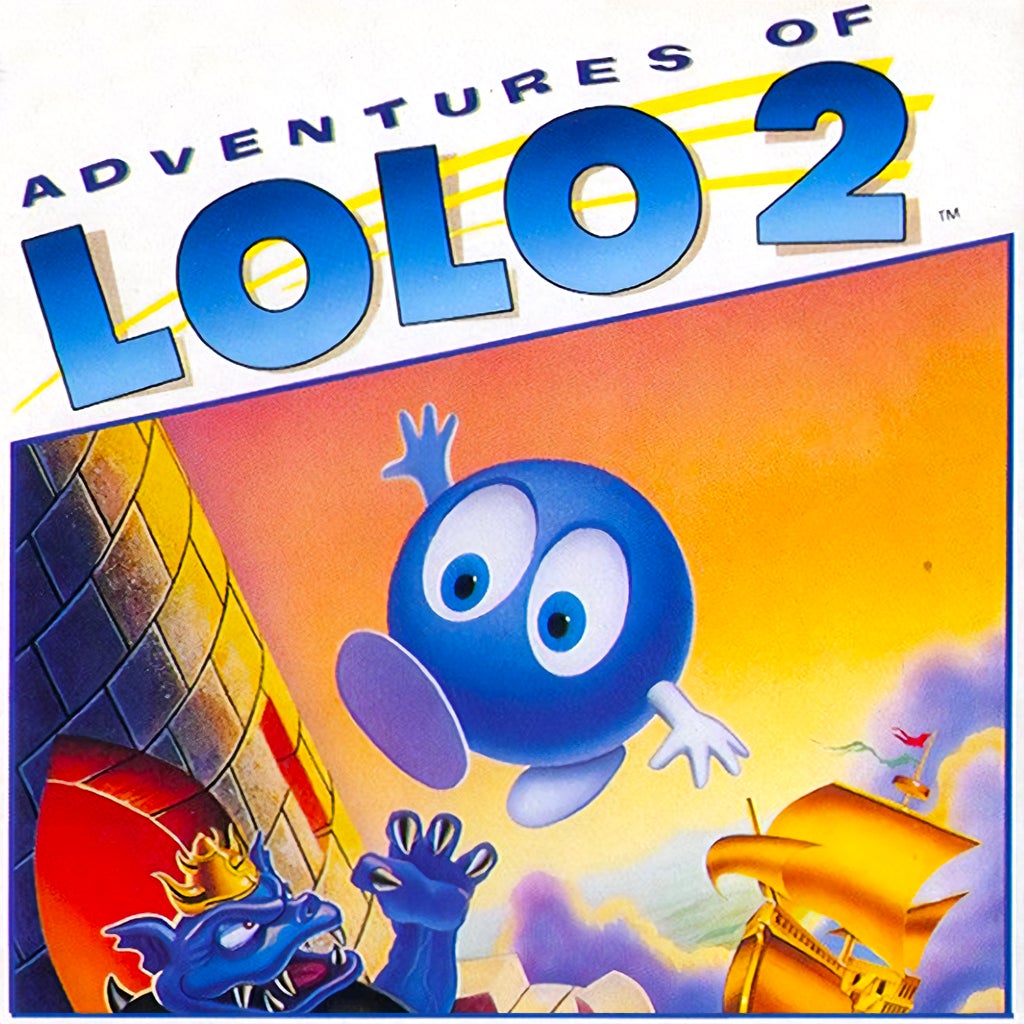
Your goal in Adventures of Lolo 2 is to collect heart framers, use them to open a locked chest, then use the key inside to ascend to the next floor. All the while, you'll be pushing boxes, avoiding enemies, and positioning items to create a safe path. Conceptually, it's a fun enough game, and a fair amount of the levels function as bite-size brain teasers that can provide some pretty satisfying solutions.
This is especially true for the first few floors or so, which lay the groundwork for basic strategy well enough, while introducing players to different elements in a smoother, steadier way than Lolo 1's set of levels did. Lolo also stands out from its puzzle contemporaries by use of its half-tile movement system, which allows for some really clever solutions—blocking two sets of enemies with one item or ensuring a group of enemies are locked in place with minimal resources.
Lolo 2's half-tile mechanics are something you'll have to figure out on your own, and while it's certainly manageable, it's an indication of the game's unwillingness to communicate information to the player. Many puzzle games rely on some form of trial and error, but Lolo 2 is consistently obscuring main game mechanics as a gimmick to extend game length. Some heart framers contain magic shots with which you can defeat enemies, but you won't know which ones until you pick them up.
Enemies can be turned into eggs (just go with it), which can then be pushed onto water and floated on like rafts, but you never know where the water leads until you float along its entire path. By far the most frustrating is the enemy hole, a hidden mechanic that spawns an enemy in another preset location if its original spawn is covered by an item. It's never taught, explained, or even alluded to by the game or its manual, and some levels of Lolo 2 are impossible to complete without it.
When you see the game's manual proudly referencing the helpline (even going as far as to mention there's a good chance whoever you talk to might not even be able to help), it becomes pretty clear that obfuscation was more of a feature than a bug.
Beyond figuring out all its mechanics, though, aside from some difficulty spikes, Lolo 2 can end up feeling pretty dull. It doesn't have enough mechanics to make 50 levels interesting, and that feeling is only exacerbated by later stages that take a long time to get through, even when you do know the solution. Its lives system is also pointless and only serves to waste more of your time by interacting with the menu every few minutes.
And frankly, the less said about the game's final boss, the better. Adventures of Lolo 2 is a fine enough game for a portion of its run time, and it has some unique ideas here and there, but between its confusing information omissions and its length, it can quickly turn to tedium as you ascend the final floors of King Egger's tower.