 Hi, I'm Palipilino!



PC
1/6/2025
Back before the phrase "dark and edgy" was a well-known trope and communal punching bag, it represented something of a cultural zeitgeist in the West from the 80s to the early 2000s. This was evident in the rise of goth, punk, and emo subcultures and could be identified in everything from the popularization of new styles of music to youth fashion trends as the world entered a new millennium. The trope became increasingly common, especially as a means of subversion; taking a traditionally family-friendly piece of media and reframing it into a more twisted and gorier version of itself.
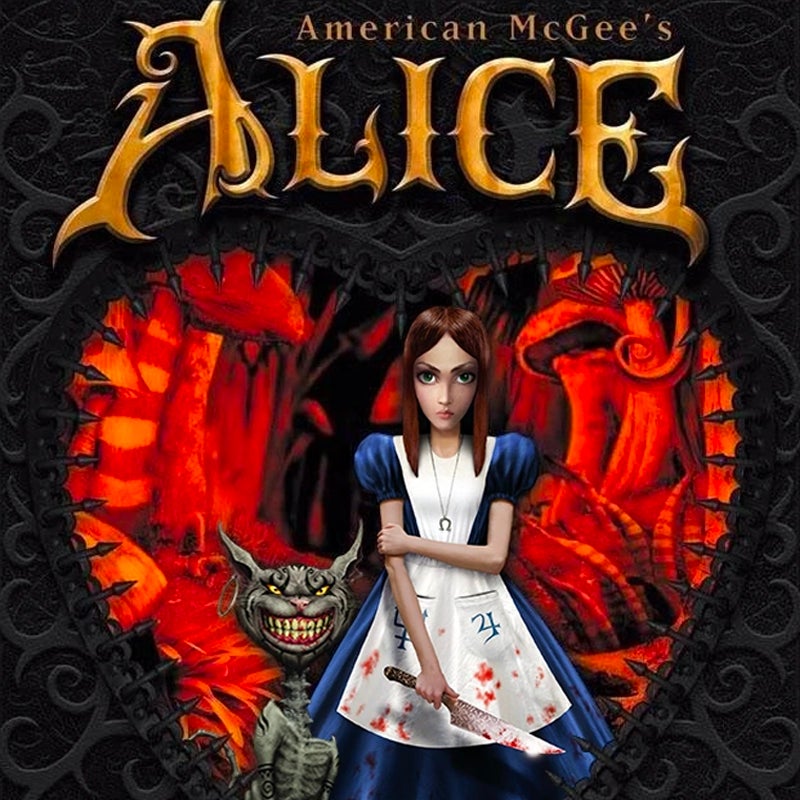
Alice's Adventures in Wonderland, the acclaimed children's novel by Lewis Carroll, wasn't a stranger to more macabre interpretations, but as its most popular adaptation was from a 1951 Disney animated film, a game such as American Mcgee's Alice was a pretty stiff departure from the surreal yet joyful image that many associated it with. Developed as a sequel to Through the Looking Glass, AMA follows Alice from the death of her parents in a house fire to an asylum, where the titular character must return once again to Wonderland in order to face the events of her tragic past.
A cynical reading of the previous paragraph might lead one to believe that the game's atmosphere is to its detriment. That couldn't be further from the truth; if there's one thing carrying American Mcgee's Alice, it's the game's outstanding art direction and tone. From the novel-inspired locales to the game's original creations, exploring this dark and dour version of Wonderland is consistently enjoyable. A lot of this enjoyment can be attributed to the game's impressive graphics and surprisingly competent voice acting for the time—the Cheshire Cat in particular deserves applause.
| Played For | 14h 33m |
|---|---|
| Completion Type | Credits w/ All Weapons |
| Favorite Weapon | Jacks |
| Favorite Area | Pale Realm |
Level design might be mostly generic, but world design was clearly a focal point for this entire project, and the game's themes of overcoming guilt and trauma are well-communicated both subtly and overtly throughout its course. AMA is undoubtedly an expression of passion, and during its most unique moments, you can feel that passion gushing from every corner. Alice's excellent aesthetic doesn't stop at just its background. Both your weapons and your enemies demonstrate interesting design choices, and both are varied enough that almost every weapon feels useful in some circumstances. It's good that some elements of the combat have variety to them, because on a whole, AMA's combat is pretty mediocre on an actual case-by-case basis. Beyond first-time encounters and trying out new weapons, enemy encounters are rarely enjoyable. Especially in later areas of the game where you're forced to take on large groups at once, it doesn't feel good to engage with the game on its terms.
Dodging large amounts of enemy projectiles with the game's unresponsive controls is not ideal, so you quickly learn that the best way to handle most fights is to exploit the poor enemy AI or the questionable hit detection system by hiding behind invisible walls and letting your adversaries vanquish themselves. And in instances when you're fighting on narrow raised platforms with lava or endless pits below, the frequently unavoidable enemy knockback can become a real source of frustration.
Boss fights don't fare much better. They all take place in a pretty open arena, and with health/mana crystals constantly spawning, your best—rather, your only—bet is just to unload your best weapon on them and run around while waiting for crystals to respawn. It's not particularly engaging, and there definitely isn't enough going for it to fill a dozen-hour game.
Though American Mcgee's Alice is billed as a 3D platformer, it functions more as a third-person shooter, and combat is certainly what you'll spend most of your time doing. Platforming is sort of an afterthought for most of the game, which works in its favor, as jumping is sluggish, aerial control is limited, and platforms are slippery. As a game released in 2000, it certainly had a wealth of potential 3D platformers to draw inspiration from, and it's disappointing to see how lacking meaningful platforming interactions are in Alice. Some areas are more engaging than others, of course, and a few of the game's puzzles can help break up the tedium.
But if you're an American Mcgee's Alice fan, you're here for the atmosphere, the set dressing. Exploration may be limited and combat may be dull, but for those who really enjoy the game's environment, these issues may not be as big of a shortcoming as they seem. It's the pure love and passion that was poured into this game's aesthetic that makes Alice as frequently enjoyable as it is, even when most moment-to-moment gameplay is middling. It's a game that's significantly more fun to experience than it is to play, but it's hard to deny the charm of it when you're not being bombarded by enemies or slipping off cliffs. A unique title that's definitely worth playing, even if a lot of its game design choices are a bit... well, mad.