 Hi, I'm Palipilino!



Xbox
9/22/2025
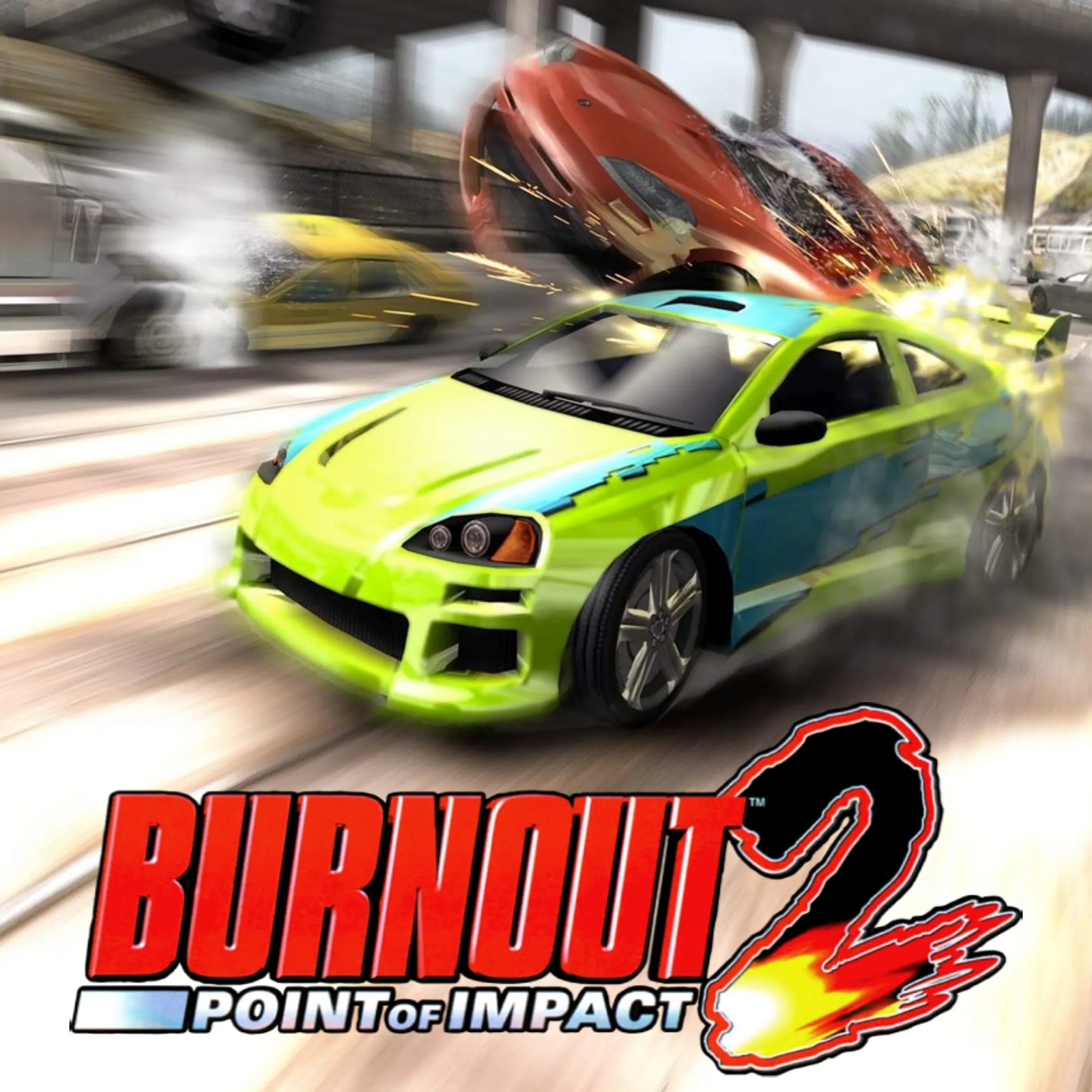
Burnout 2 is one of those games that, while certainly a success in its own right during its time of release, has henceforth developed a reputation as a typical transition title. The first Burnout game was subject to modest praise but otherwise got lost in a sea of other 6th-gen racers, and the third—subtitled Takedown—is considered by many to be the finest in the entire series. That kind of gap in quality can happen sometimes between sequels, but it's probably more common for there to be a game to bridge the gap.
Burnout 2: Point of Impact is certainly a strong example of such a phenomenon. It refined the baseline mechanics of its predecessor in a way that makes it a competent arcade racer, as well as adding some new modes that would become series regulars. And while further refinement would work wonders with its sequel, Burnout 2 often shows that, at its core, it has enough quality to rebuke its status as just a stepping stone to Burnout 3.
The most notable improvement this game brings to the table is the driving, and boy, is it an improvement. Burnout 2 is fundamentally a fantastic arcade racer; controls are slippery yet precise, allow for a low barrier of entry while permitting an absurd amount of skill expression, and its risk-reward system is dynamic and engaging. Just like the first, you generate Boost via risky driving—wrong side of the road, near misses, drifting, etc.—yet the actual feel of the car is improved by an order of magnitude. It's a perilous dance of pushing as much speed out of your car as possible, whipping around every corner and narrowly dodging every obstacle, while retaining just enough control of your car to keep it out of harm.
| Played For | 10hr 18m |
|---|---|
| Completion Type | All Gold Medals, All Cars, All Challenges |
| Favorite Car | Custom Roadster |
It's textbook high-octane racing, and it offers some excellent fun in its split-screen multiplayer as well, though admittedly with some infrequent frame rate drops. There can be some puzzling decisions made by the pedestrian vehicles that are unfortunate enough to share the road with you—they will, on occasion, merge directly into your oncoming car, causing a massive collision—and while that can be a bit frustrating, the invisible hand of bad AI usually strikes pretty equally in this game. It's also lessened by the fact that crashes, while visually impactful, don't actually set you back that far, preserving the game's arcade philosophy.
But while its core racing feels great, it is rarely pushed to its limits beyond player-enacted goals or time trials. Your AI opponents are quite prone to crashes themselves, and it seems like no matter how strong of an advantage they are given, they will usually settle in around 3 or 4 seconds behind the player after a lap or two. This isn't helped by the fact that the game gives you the best car around halfway through the campaign; the custom series championships are rendered mostly ineffective as a result.
That normally wouldn't be too big of an issue for a game with such strong driving, but track variety is desperately lacking in Burnout 2—an aspect it did not improve upon enough in its sequel. There are 79 gold medals to achieve and, generously, only 5 or 6 actual tracks to race on. Sure, some courses are remixed slightly or reversed, but you are likely to develop an intimate knowledge of each track long before you reach the game's conclusion. And since Burnout 2 rarely (if ever) challenges the player, the difference between events is likely to blur, and the game's second half blends into routine monotony.
It does aspire to add a healthy amount of variety that the original was sorely lacking, to mixed results. Its Crash mode functions as Burnout 2's sort-of puzzle mode, giving the player specific scenarios and challenging them to rack up the most amount of money in damages. It functions perfectly well as a fun little distraction in single or multiplayer. Pursuit mode, on the other hand, is very weak; car combat in this game is woefully unrefined, and your car never feels like it has any weight behind it.
Your fellow racers (or fleeing suspects) operate on completely different physics than the NPC cars do; as a result, the same collision that would send your car flying through the air with an NPC car will feel like a passing glance with a fellow racer. And in Pursuit mode, all contact is created equal—a tap on the rear bumper is equivalent to a full-speed collision. It encourages the absolute opposite of what makes the Crash mode a fun time, and in some instances, a collision can wreck both your car and theirs...only for the pursued to magically reassemble and continue on driving.
It's no wonder that the Pursuit element was focused on in Burnout 3; it was an exciting addition that needed a lot of work to live up to its potential. But Takedown was only able to focus on it so much because of the great work Point of Impact did on the fundamentals. And when you strip away its accessories—a poorly implemented Pursuit mode or its frequently dull, overstuffed campaign—Burnout 2 reveals a pretty spotless engine.