 Hi, I'm Palipilino!




Nintendo DS
10/1/2025
On the sliding scale of "sequels are basically the same exact game" and "sequels might as well be in a completely different series," Castlevania would probably be one of the more notable franchises that occupies an area more towards the latter. Thematically they're very consistent in tone, of course, with gothic scenery and a heavy inspiration from a series of mid-20th-century horror films. But it's particularly renowned for its gameplay evolution, and its journey from a side-scrolling arcade platformer to a genre-defining 2D RPG is well documented.
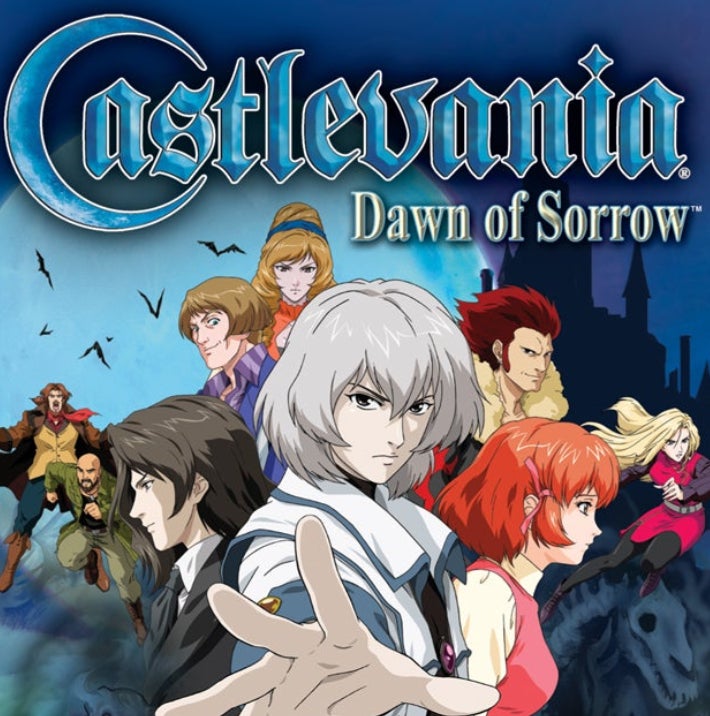
But every rule is made to be broken, and when Konami developed the GBA's final Castlevania, Aria of Sorrow, it was clear they felt they were onto something—surely the massive critical acclaim and impressive international sales helped with that sentiment. So with the Nintendo DS and its new technology looming, it was decided their first entry on the system would lean heavily on Aria's innovations—a justifiable decision when the result was 2005's Dawn of Sorrow.
Given that Dawn of Sorrow has you reprising your role as Soma Cruz, it makes sense that Aria's groundbreaking Monster Soul system returned as well, and it's just as good as ever. Between an assortment of bullet-like abilities, lingering effects, and transformations, DoS provides a cornucopia of builds to test against the multitudes of evil creatures that inhabit the cult's headquarters. And while a large amount of options is good, better is a game that actively encourages the use of them, and that's where Dawn of Sorrow really shines. Its enemy and boss design is as good as you'd expect from the series, and particularly great about them is how uncompromising they can be to someone who is not willing to adapt their playstyle.
| Played For | 8h 57m |
|---|---|
| Completion Type | 99.1% Completion |
| Favorite Monster Soul | Witch |
| Fun Fact | This is only my second Castlevania! Soma Cruz is cool! |
You can brute force your way through everything, sure, but it feels much better to engage with the game on its terms and treat each boss sort of like a puzzle—what combination of souls and weapons will give me the best chance at victory? And the ability to swap between two setups is helpful as well, encouraging modularity as well as keeping the player in the game as much as possible. And the returning Julius mode unlocked upon completion provides a Classicvania experience that is bound to satisfy fans of the series.
In addition to their use as abilities, Dawn of Sorrow utilizes Monster Souls to facilitate a weapon crafting system, with some more mixed results. On one hand, the infrequent drop rate of souls will mean that you're basically forced to upgrade whatever you happen to have, and it encourages players to try out other weapon styles that they might not have gravitated towards.
On the other hand, grinding for drops is not particularly enjoyable in Dawn of Sorrow, and a particularly bad bout of RNG can make one yearn for the days of finding a strong weapon as a reward for exploration instead of as a result of a lottery. And any time you explicitly need souls from non-boss monsters for progression or exploration is when you start to wonder what the point of all this is. It doesn't hamper a standard playthrough all that much, but an attempt at 100% completion would be a fool's errand—a bigger detriment than usual given the genre and its tendency to encourage a full completion.
The weapon synthesis, at least, does add a new angle to what is a very familiar skeleton. Dawn of Sorrow definitely feels like it misses some chances to introduce changes from its predecessor, and it probably relies on Aria's structure a bit too much for a brand-new game on new hardware. Its principal addition is its Magic Seal system, which requires you to trace some symbols at the end of certain boss fights.
It's completely inoffensive, but it also just feels like the result of Konami implementing a touch-screen gimmick out of reluctance rather than actual interest. The DS does allow for some pretty impressive visuals, from its parallax scrolling backgrounds to its detailed sprite work; as you'd expect from Castlevania, the game's presentation is superb, and its soundtrack and backgrounds evoke the feelings of franchise classics.
Perhaps with the switch to a new console, the relative safeness of Dawn of Sorrow is more understandable. This was coming off the most highly acclaimed game in the series since the iconic Symphony of the Night, after all, and Aria's mechanisms definitely had plenty of potential for further growth. Dawn of Sorrow's main flaw is that it used its predecessor as more of a template than a springboard, and its quality ceiling was probably always destined to be bound by that fact. But that still leaves a lot of room for a high-quality game, and that's exactly what Dawn of Sorrow is. It, itself, established a foothold on the DS that would begin what is probably the most beloved trilogy of games in the entire Castlevania series. And if the worst thing that Dawn of Sorrow is guilty of is that it borrows too much from another fantastic game? Well, you could do a lot worse than that.