 Hi, I'm Palipilino!



PlayStation 2
3/30/2025
First-person shooters on the personal computer were in a very different place than their home console counterparts back in 2000. On one hand, you had games like Half-Life and Unreal Tournament, which were breaking new ground for the genre on PCs and generally feel like the beginning of homogenized controls for FPS games on the mouse and keyboard—many modern games control basically the same way. In the home market, though, the definitive standouts were GoldenEye 007 and Perfect Dark, a pair of Rareware N64 titles. They, too, seemingly offered the promise of a new beginning for console FPS titles.
Time would reveal their control schemes to be more incremental changes towards a final design, though, rather than the finished article. What held them both back, of course, was the singular joystick on the N64 controller—a problem the PlayStation 2 and its new DualShock 2 controller would be able to solve. These two games were massively influential, of course, and the genre would certainly not be the same without them. But for a glimpse at the world where GoldenEye became the template to follow—where it was the final step in home console FPS design—we can cast our eyes towards TimeSplitters.
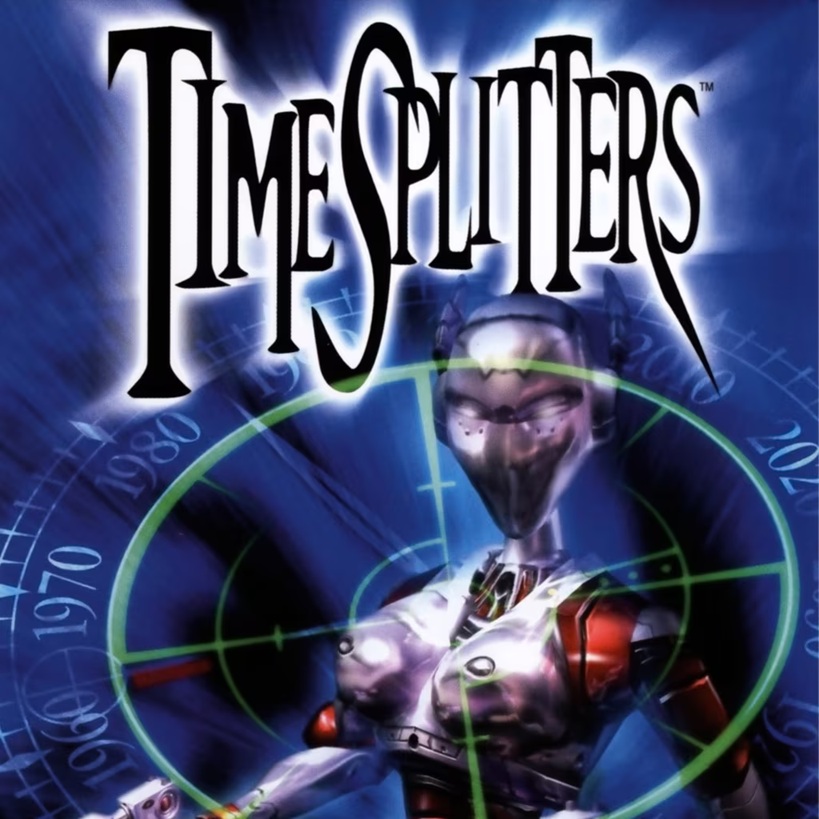
Developed by Free Radical Design as one of the 29(!!) launch titles for the PlayStation 2, TimeSplitters didn't even have the privilege to debut as the console's only FPS; it was competing with several other titles right out of the gate. So what did TimeSplitters have to offer to prospective players? Well, severely enhanced graphics, for one. Visually, going from N64's Perfect Dark to this—released just five months apart—is a massive leap, all while running at a relatively smooth frame rate.
| Played For | 8h 46m |
|---|---|
| Completion Type | All Missions, All Difficulties, All Time Reqs |
| Favorite Level | Village |
| Fun Fact | I spent half of this time just trying to beat Mansion... |
Its multiplayer mode—generally the aspect of GoldenEye that is most fondly remarked on—is extremely comprehensive, supporting 4-player split-screen multiplayer, an incredible roster of characters, and an impressive list of game modes to play against either friends or bots. Even more options, such as cheats, secret characters, and extra stages, are unlockable via the game's story mode. Regardless of anything else, TimeSplitters is certainly a game that can hold its own in the local multiplayer FPS sphere.
If you're a single player, though, you're likely to notice that everything that isn't the multiplayer mode seems to be not-so-gently pushing you in its direction. Let's be frank; the GoldenEye and Perfect Dark comparisons are not without reason, as most of the Free Radical Design team previously worked at Rare. And so a lot of TimeSplitters' quirks start to make more sense: varying difficulties, time-based unlocks, an emphasis on multiplayer content, and, unfortunately, a very similar control scheme.
So even with 2 joysticks, aiming in TS feels very imprecise, and a large portion of your combat will consist of firing from the hip and hoping the game's auto-aim system does the rest. This works okay enough in a lot of cases, but any time precision is required, it kind of falls apart. This rings true especially for the game's most notorious story mission, Mansion, in which almost every enemy can only be defeated with a headshot. So poorly laid out is this level that even the developer seems to be aware of it, as indicated by its outrageously long speedrun reward time.
Speaking of the game's story mode, that's where TimeSplitters loses a lot of points when compared to its N64 pair of progenitors. Calling it a story mode at all is an overstatement. There's certainly no narrative here, and its nine missions can all be described the same way—capture the flag on multiplayer maps against a large number of bots. It gets stale playing the game as a normal FPS, but if you're chasing the reward times, it's not very enjoyable for an entirely different reason.
For some reason, only the Easy difficulty times actually have any semblance of an efficient run, and many of the Normal and Hard mode times can be reached without too much thought or challenge. And any attempt at incorporating actual speedrunning strategies into your gameplay will usually have you finishing with minutes to spare. The aforementioned Challenge Mode, unlocked by beating all the story missions, suffers an unfortunately similar fate.
That's not to deny that it's not fun to dance past enemies and blast everything in your way sometimes. TimeSplitters can serve up moments of exhilaration, but so can many of its competitors—which tend to have a lot more going for them. That's probably why the later TimeSplitters titles have been the subject of more retrospective praise and why the debut doesn't get mentioned as much. It was only a PS2 launch title, and it deserves some credit for how natural it feels on the system. But it borrows too much from its predecessors without the innovations of its sequels to feel like much more than a pretty-looking but pretty bare-bones proof of what turned out to be a very beloved concept.