 Hi, I'm Palipilino!



Xbox
4/14/2025
Depending on your definition of what a stealth game is, you could claim that the genre dates all the way back to arcade games in the 1980s—heck, Wikipedia even lists Pac-Man as an early example. But general use of the term in the modern day alludes to more than the act of avoiding enemies, and mainstream success of the genre only really began with a pair of 1998 titles, Metal Gear Solid and Thief. These titles would have a lasting impact on stealth games and action games in general, and it wouldn't be long until that impact was visible. One of the more identifiable examples is the Splinter Cell series.
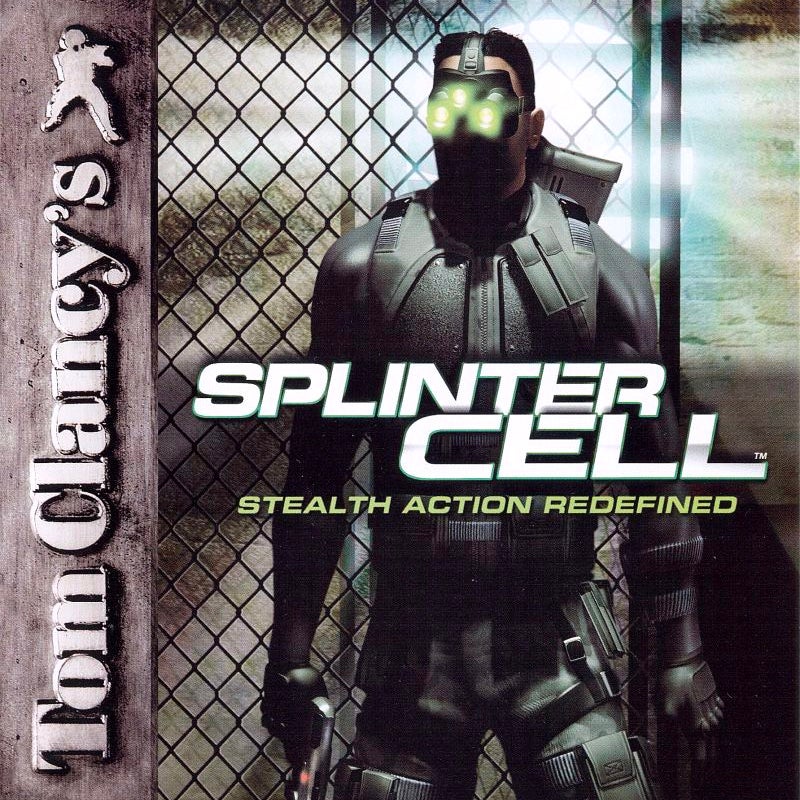
Developed by Ubisoft and bearing the possessive "Tom Clancy's," Splinter Cell was not, as it may appear, developed by the American author whose name it bears. Rather, Ubisoft was allowed to utilize Tom's endorsement—and name recognition—after the video game company he founded was bought by the French developer in 2000. With the game's producer acknowledging Metal Gear Solid as the primary inspiration, 2002's Tom Clancy's Splinter Cell was the start of a successful 6th generation series, albeit with a less than timeless debut.
With a strong focus on stealth gameplay, it should be noted that Splinter Cell's debut does a pretty good job of enticing the player to adhere to its preferred play style. Even in missions that allow you to use lethal force, you're outfitted with a limited amount of ammo, and you're further discouraged from using it via Splinter Cell's not-so-precise aiming. Don't take that as a slight, though—remember, most instances in this game are designed to be solved without necessarily resorting to combat, and while it's nice that the game is generally generous with options of progression, it's usually most enjoyable when played as advertised.
| Played For | 14h 21m |
|---|---|
| Completion Type | Played on Medium Difficulty |
| Favorite Mission | Chinese Embassy 2 |
And freedom of movement is certainly emphasized here; even though levels are mostly pretty linear, your actual path through them can be open to a lot of your own interpretation. Splinter Cell is at its best when you're free to observe from the shadows, note down your enemies movements, and figure out ways to subdue them—or better yet, slip by completely undetected. The way the game utilizes light and sound goes a long way in providing its atmosphere, and in particularly tense sections, you may find yourself instinctively holding your breath, lest you rouse the suspicion of enemy forces.
There are moments, though, when it feels like no amount of observation will get the job done. As a result, sections of Splinter Cell will probably feel more like trial and error than cunning stealth action. This is mainly due to some pretty inconsistent AI behaviors; regardless of how well you appear to be hidden, there are more than enough moments where enemies will be alerted to your presence to make the game feel a bit too random.
Take your silenced weapon, for example; shooting a camera with it will make nearby enemies suspicious, but if you're hidden well, they still won't be able to find you. Shooting (and killing) an enemy, though, will result in every other combatant in the nearby area locating you instantly, even in pitch-black conditions. As mentioned previously, Splinter Cell is not shy about encouraging a stealth-over-combat approach, but it enforces its own rules too erratically to feel like the realistic stealth action it was trying to emulate. There are also sections where stealth is simply not an option, and those are the moments you'll be wishing for some better gunplay—or, heavens, at least a more truthful crosshair.
The game's story is mostly nothing to write home about—if you've read one story about an American covert ops soldier fighting in the shadows against Russia/China/etc. to prevent World War 3, you've read them all—but it's a little disappointing that it pulls so many of its punches. Sure, when you see Tom Clancy's name attached to a product, you probably expect a fair degree of nationalism, but the concept of working for the National Security Agency as, well, a splinter cell, and utilizing "fifth freedom" rights to ignore all laws and ethics is far too on-the-nose of a concept to be played straight with any degree of sincerity, and any signs of dissent shown in the game are threads that are pulled at far too infrequently.
It's easy enough to write off Splinter Cell's debut narrative as a cheesy American action movie, but when the gameplay works, it's hard to deny its enthralling nature. Every stealth section feels like a 3D puzzle, and navigating them without the use of violence can be a really satisfying experience. It's conceptually interesting, but the clunky movements, the awkward aiming, and some sometimes clairvoyant enemies make it too inconsistent to feel like an overall enjoyable experience. The beginning to a successful series, Tom Clancy's Splinter Cell is a sometimes thrilling but altogether uninspiring answer to the PlayStation series that inspired it; a "Metal Gear Solid 2 killer" it was not.